They didn't crack the vault, they cracked a laptop
About $6 billion vanished from Binance, and the keys never left their place. One engineer's machine was enough. What it means for your company and your crypto.
What happened
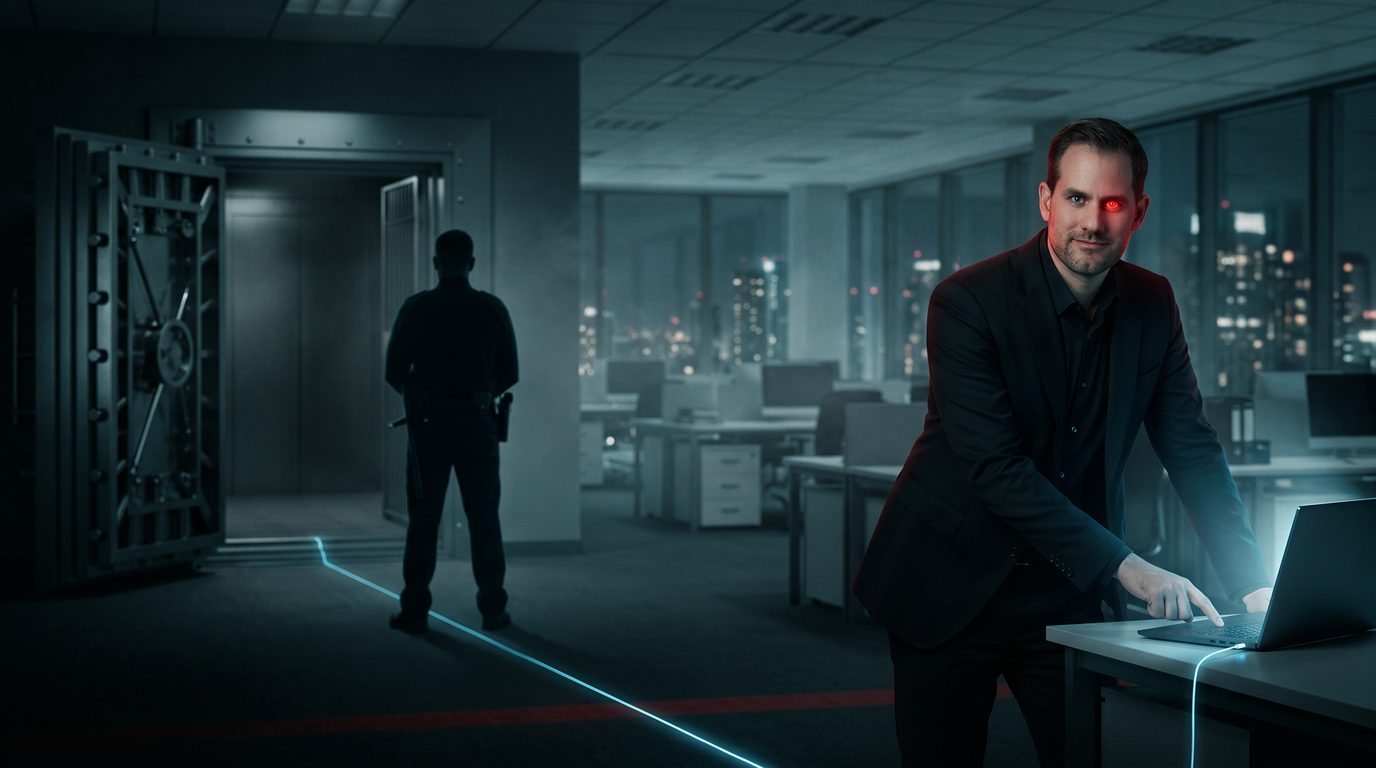
Say “bank robbery” and you probably picture a film scene: drills, a vault door, sweaty foreheads, a guard in the corner. Forget all that. In the biggest crypto heist so far, nobody touched the vault. The attackers got behind the teller’s window through one employee’s laptop, and from there the till paid them out by itself.
On Thursday, 29 October 2026, assets started pouring out of the wallets of Binance, the world’s largest crypto exchange. Users and blockchain watchers noticed first; then founder Changpeng Zhao wrote on X that the exchange had probably been hacked. Shortly after, Binance confirmed it was handling a security incident.
The numbers are dizzying, and they don’t quite match. Binance puts the estimated total impact at about $6.3 billion; blockchain analytics firm Chainalysis puts the value at the moment of theft at about $5.9 billion. They measure different things, but either way it’s the largest crypto theft ever, roughly four times the Bybit case of February 2025 (about $1.5 billion). The attackers took bitcoin, ether and two big stablecoins (crypto tokens pegged to the dollar), USDT and USDC.
What struck me most was the method. According to Binance’s preliminary investigation, the starting point was most likely the compromised laptop of a DevOps engineer (someone who both builds and runs systems). From that machine, the attacker reached an internal service container, one of the exchange’s running software components, and submitted unauthorised withdrawals from there. The company says there is no sign that the wallets’ private keys leaked. So the keys stayed put; someone else simply told them what to sign. Binance hasn’t yet disclosed how the laptop was compromised or which controls failed to stop the outflow, and has promised a detailed post-mortem.
Damage control kicked in fast. According to Binance, about $3 billion of the affected assets were frozen together with partners: Tether froze more than 1.57 billion USDT, Circle more than 800 million USDC. That’s money stopped, not money recovered. Bitcoin and ether, however, can’t be frozen centrally, and the attacker quickly swapped part of the haul. Binance has pledged to cover the losses from its user protection reserve (SAFU) and its own funds. Deposits resumed on 30 October 2026; withdrawals, by the company’s estimate, within 48 hours.
Who’s behind it? Binance hasn’t named anyone. Blockchain analytics firm TRM Labs attributes it “with high confidence” to TraderTraitor, a North Korean state-backed group. The FBI previously named the same group behind the DMM Bitcoin (2024) and Bybit (2025) heists, and in both cases a developer’s machine was the way in. There’s no official confirmation for this case yet.
Why it matters to you
If you hold crypto, on Binance or anywhere else, your money is probably not at risk from this heist itself. Binance has pledged to absorb the loss. The threat to you is the second wave. After big heists, scammers ride the news: “Binance support” calls, a text says “your account was hacked”, someone offers “compensation registration” or “fund recovery”, for a fee, of course. In February 2025, days after the Bybit heist, exactly this happened to Binance customers.
If you run a company, the lesson isn’t about crypto. One employee’s machine was enough to reach the payouts, because too much trust sat behind it. Ask yourself: whose laptop is worth that much at your place?
No impact in Hungary is known, and as of 30 October 2026 we found no warning from Hungarian authorities. Across Europe, the second wave can arrive in any local language.
For professionals: technical details
- CVE: none; Binance hasn’t named a vulnerability. Based on current knowledge: endpoint compromise and abuse of internal access.
- Disclosed chain (preliminary): DevOps engineer’s laptop → internal service container → unauthorised withdrawal transactions. Binance says no private key leaked and several factors contributed; it is rebuilding the withdrawal service and related addresses.
- Attribution: TRM Labs: TraderTraitor (Jade Sleet, UNC4899, Slow Pisces), “high confidence”; Blockaid and ZachXBT: North Korea. No public evidence and no official confirmation as of 30 October 2026.
- Precedents: DMM Bitcoin (2024, $308 million): fake recruiter, coding test, stolen session cookies, manipulated transaction request (FBI). Bybit (February 2025, about $1.5 billion): code planted in the web interface via a Safe{Wallet} developer’s machine.
- MITRE ATT&CK (editorial mapping, assumption): T1566 / T1204 (the group’s known lure, not confirmed here), T1539 and T1550 (confirmed in the DMM case), T1078, T1021 / T1610-type movement towards the container environment, T1657.
- Detection ideas: withdrawal requests from an unusual internal source or schedule; amount and count anomalies in a short window; new, unknown code repositories or unusual browser extensions on admin endpoints; the same session from an unusual place or device; container access from a developer machine outside working hours or without a change ticket.
- Indicators: no official consolidated IOC list; attacker addresses are tracked by blockchain analytics firms (Arkham, Chainalysis, TRM Labs). Background: SEAL’s February 2025 DPRK advisory, the FBI IC3 warning on fund recovery scams.
Background report for professionals
The full research in one PDF
Timeline, actors, how the attack works, actions for each audience, technical details and source assessment. All in one place, printable and easy to pass on.
Sources
- Binance Square – Binance News: incident summary
- CoinDesk: Binance loses over $6 billion
- The Hacker News: Binance suffers security breach
- CyberInsider: Binance links $6.3B incident to compromised laptop
- Fortune: What we know about the Binance hack
- TechCrunch: Binance pauses withdrawals
- Portfolio: Unprecedented hack hits Binance (in Hungarian)
- HVG: Serious hack hits Binance (in Hungarian)
- BleepingComputer: FBI links North Korean hackers to $308M DMM heist
- The Hacker News: Bybit hack traced to Safe{Wallet}
- SEAL Radar: DPRK advisory (February 2025)
- NCSC Switzerland: Binance-branded SMS scam
- FBI IC3: fund recovery scams (PSA230811)
Made with the AI crew, reviewed by Péter
- The AI crew
- Collected and cross-checked company statements, authority, researcher and press sources, produced the deep-dive research and the background report, wrote the draft, the English version and the video script, and came up with the cover image idea.
- Me
- I picked the topic and the angle, adopted the cover image idea, wrote my closing note, which the AI crew then expanded, and reviewed and approved the post.
Before publishing I checked every claim myself, and the opinions are mine.